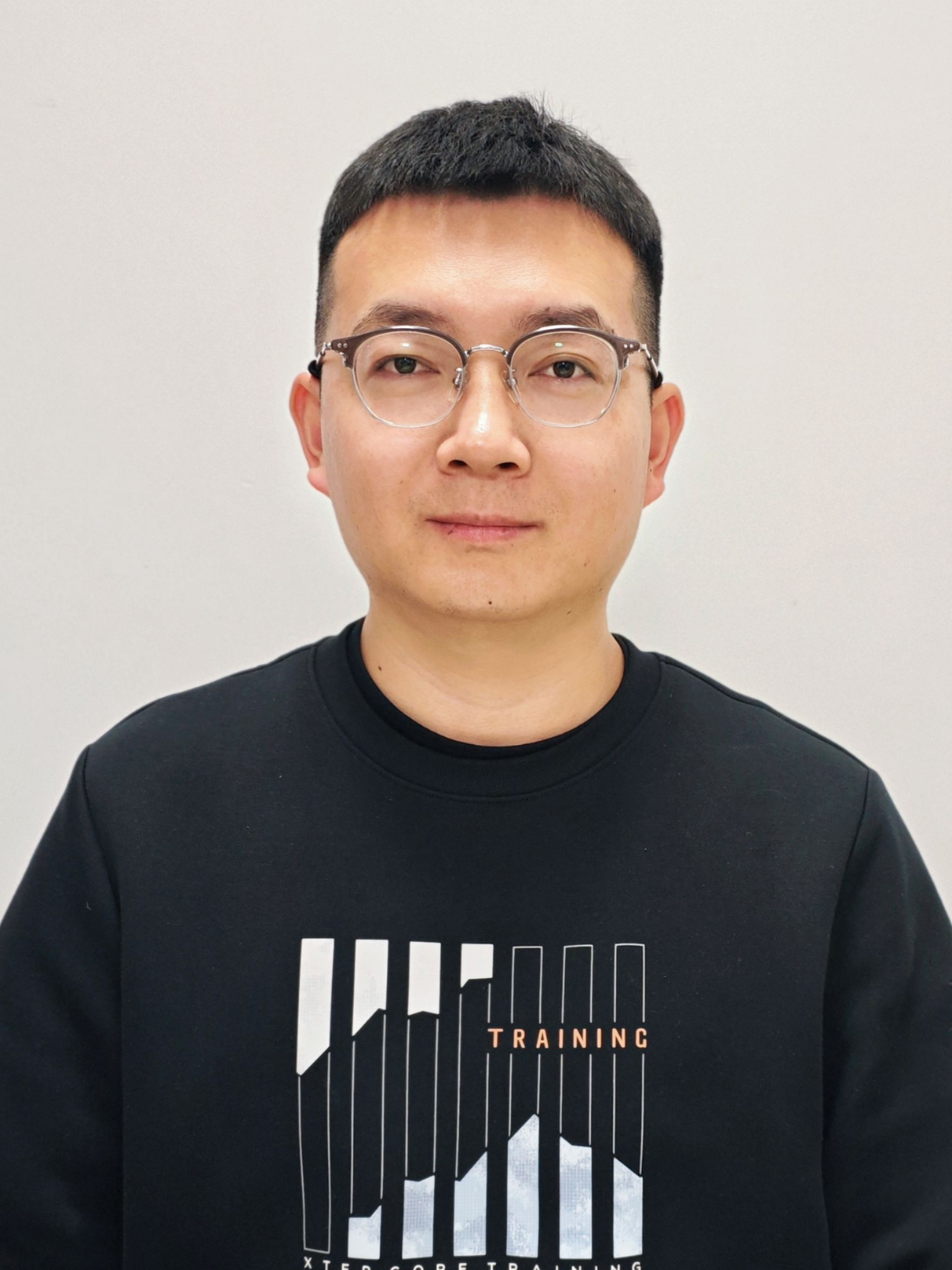
个人简介
刘志刚,男,东莞理工学院特聘副研究员、高层次人才。研究主要围绕大数据智能计算与图计算领域,聚焦高维不完备数据分析、高阶异质网络表示学习与社区发现等方向,在IEEE Trans. NNLS、IEEE Trans. SMC-Systems、IEEE/CAA JAS、Information Fusion、IEEE Trans. ASE、IEEE Trans. NSE、IEEE Trans. ETCI、IJCAI等国际著名期刊和会议上发表SCI/EI检索论文30余篇(第一(学生)作者/通讯作者论文21篇),其中IEEE汇刊/期刊论文15篇、CCF推荐会议论文5篇,3篇获评ESI高被引论文,谷歌学术引用2000余次。获得授权国家发明专利10项。主持教育部人文社会科学研究青年基金项目1项、中国博士后科学基金项目1项、广东省基础与应用基础基金青年基金项目1项、重庆邮电大学博士研究生创新人才项目1项;主研国家自然科学基金国际(地区)合作与交流项目、面上项目等;获得第21届环太平洋人工智能国际会议(CCF-C类会议PRICAI 2024)最佳论文奖、博士研究生国家奖学金、中国科学院重庆绿色智能技术研究院院长特别奖等。担任《Intelligent Oncology》期刊青年编委。担任IEEE Trans. KDE、IEEE Trans. NNLS、IEEE Trans. CYB、IEEE Trans. ETCI、IEEE/CAA JAS、AAAI、SMC等多个重要期刊和会议审稿人。
主页:https://scholar.google.com/citations?hl=zh-CN&user=vYt6c04AAAAJ
邮箱:liuzhigang@dgut.edu.cn
教育及工作经历
2025.11-至今:东莞理工学院,计算机科学与技术学院,特聘副研究员
2023.06-2025.10:电子科技大学-东莞理工学院联合培养,计算机科学与技术,博士后
2019.09-2023.06:重庆邮电大学-中国科学院重庆绿色智能技术研究院联合培养,计算机科学与技术,工学博士(导师:罗辛教授)
2016.09-2019.06:重庆大学,计算机学院,计算机技术领域专业硕士(导师:罗辛教授)
2013.07-2016.08:中国电信集团甘肃公司,公司职员
2009.09-2013.06:重庆邮电大学,计算机科学与技术学院,工学学士
研究方向
大数据智能分析、图机器学习、社区发现、人工智能应用
获奖情况
2025年,第9届电子信息技术与计算机工程国际学术会议(The 9th International Conference on Electronic Information Technology and Computer Engineering (EITCE 2025))最佳论文海报展示奖
2024年,第21届环太平洋人工智能国际会议(The 21th Pacific Rim International Conference on Artificial Intelligence (PRICAI 2024))最佳论文奖(CCF-C类)
2021年,中国科学院重庆绿色智能技术研究院/中国科学院大学(国科大)重庆学院院长特别奖
2020年,博士研究生国家奖学金
科研项目
[1] 教育部人文社会科学研究青年基金项目, 基于高阶异质网络社区结构分析的科技信息服务推荐研究——以东莞市智能制造为例, 8万元, 2025-04至2028-06, 主持
[2] 中国博士后科学基金第77批面上资助, 基于张量表示的高阶异质网络社区结构分析研究, 5万元, 2025-07至2025-10, 主持
[3] 广东省基础与应用基础研究基金区域(粤莞)联合基金-青年基金项目, 基于约束融合低秩表示学习的慢性病共病模式识别方法及应用研究, 10万元, 2024-02至2027-02, 主持
[4] 重庆邮电大学博士研究生人才项目, 基于不完备数据隐特征分析的冠心病初筛方法研究, 3万元, 2020-10至2023-06, 主持
[5] 国家自然科学基金国际(地区)合作与交流项目重点项目, 面向大豆增产提质的植株表型与多模态数据融合分析建模关键技术研究, 200万元, 2025-01至2027-12, 参研
[6] 国家自然科学基金面上项目, 面向海绵城市运维大数据的高维稀疏张量分析方法研究, 56万元, 2021-01至2024-12, 参研
代表性论文
[1] Zhigang Liu, Hao Yan, Yurong Zhong, and Weiling Li*. A relaxed symmetric non-negative matrix factorization approach for community discovery (Extended Abstract), Proceedings of the Thirty-Fourth International Joint Conference on Artificial Intelligence (IJCAI-25), 2025: 10916-10921.(CCF-A类)
[2] Ying Shi and Zhigang Liu*. A multi-constrained matrix factorization approach for community detection relying on alternating-direction-method of multipliers, IEEE/CAA Journal of Automatica Sinica, 2025, 12(4): 827-829.(中国科学院一区)
[3] Zhigang Liu, Xin Luo*, and MengChu Zhou. Symmetry and graph bi-regularized non-negative matrix factorization for precise community detection, IEEE Transactions on Automation Science and Engineering, 2024, 21(2): 1406-1420.(中国科学院二区)
[4] Zhigang Liu, Xin Luo*, Zidong Wang, and Xiaohui Liu. Constraint-induced symmetric nonnegative matrix factorization for accurate community detection, Information Fusion, 2023, 89(2023): 588-602.(中国科学院一区)
[5] Zhigang Liu, Yugen Yi and Xin Luo*. A high-order proximity-incorporated nonnegative matrix factorization-based community detector, IEEE Transactions on Emerging Topics in Computational Intelligence, 2023, 7(3): 700-714.(中国科学院二区)
[6] Zhigang Liu, Guangxiao Yuan, and Xin Luo*. Symmetry and nonnegativity-constrained matrix factorization for community detection. IEEE/CAA Journal of Automatica Sinica, 2022, 9(9): 1691-1693.(中国科学院一区)
[7] Zhigang Liu, Xin Luo*, and Zidong Wang. Convergence analysis of single latent factor-dependent, nonnegative and multiplicative update-based nonnegative latent factor models. IEEE Transactions on Neural Networks and Learning Systems, 2021, 32(4): 1737-1749.(中国科学院一区)
[8] Xin Luo(导师), Zhigang Liu, Long Jin*, Yue Zhou, and MengChu Zhou*. Symmetric nonnegative matrix factorization-based community detection models and their convergence analysis. IEEE Transactions on Neural Networks and Learning Systems, 2022, 33(3): 1203-1215.(中国科学院一区)
[9] Xin Luo(导师), Zhigang Liu, Mingsheng Shang, Jungang Lou*, and Mengchu Zhou*. Highly-accurate community detection via pointwise mutual information-incorporated symmetric nonnegative matrix factorization, IEEE Transactions on Network Science and Engineering, 2021, 8(1): 463-476.(中国科学院一区)
[10] Xin Luo(导师)*, Zhigang Liu, Shuai Li, Mingsheng Shang, and Zidong Wang. A fast nonnegative latent factor model based on generalized momentum method. IEEE Transactions on Systems Man Cybernetics: Systems, 2021, 51(1): 610-620.(中国科学院一区)
[11] Xin Luo, Yue Zhou, Zhigang Liu, and Mengchu Zhou*. Fast and accurate non-negative latent factor analysis of high-dimensional and sparse matrices in recommender systems. IEEE Transactions on Knowledge and Data Engineering, 2021, 35(4): 3897-3911.(CCF-A类、中国科学院二区)
[12] Xin Luo, Yue Zhou, Zhigang Liu, Lun Hu*, and Mengchu Zhou*. Generalized nesterov's acceleration-incorporated, non-negative and adaptive latent factor analysis. IEEE Transactions on Services Computing, 2021, 15(5): 2809-2823.(CCF-A类、中国科学院一区)
[13] Wanghui Xiao and Zhigang Liu*. An improved U-net model for offline handwriting signature denoising. Proceedings of the 9th International Conference on Electronic Information Technology and Computer Engineering (EITCE-25), IET, 2025: 190-193.
[14] Zhiagng Liu, Xiaoye Li, and Yurong Zhong*. HCNTF: a high-order connectivity patterns-integrated non-negative tensor factorization approach for community discovery. Proceedings of the 9th International Conference on Electronic Information Technology and Computer Engineering (EITCE-25), IET, 2025: 62-68.
[15] Hao Yan and Zhigang Liu*. High-order connectivity patterns-incorporated contrastive learning for community detection. Proceedings of the 9th International Conference on Electronic Information Technology and Computer Engineering (EITCE-25), IET, 2025: 50-56.
[16] Zhigang Liu, Weiling Li*, and Yurong Zhong, Boosting a non-negative matrix factorization-based community detector via graph convolution regularization, Proceedings of the 2024 IEEE International Conference on Systems, Man and Cybernetics (IEEE SMC-24), IEEE, 2024: 5022-5028.(CCF-C类)
[17] Zhigang Liu, Hao Yan, Yurong Zhong* and Weiling Li*, A relaxed symmetric non-negative matrix factorization approach for community discovery, Proceedings of the the 21th Pacific Rim International Conference on Artificial Intelligence (PRICAI-24), Springer, 2024: 119-133.(CCF-C类)
[18] Yu Song and Zhigang Liu*. An unsupervised online streaming feature selection algorithm with density peak clustering. Proceedings of the 2023 International Conference on Networking, Sensing and Control (ICNSC-23). IEEE, 2023: 1-6.
[19] Zhigang Liu and Xin Luo*. Convergence analysis of an SLF-NMU algorithm for non-negative latent factor analysis on a high-dimensional and sparse matrix, Proceedings of the 2019 IEEE International Conference on Systems, Man and Cybernetics (IEEE SMC-19), 2019: 1750-1756.(CCF-C类)
[20] Zhigang Liu, Xin Luo*, and MengChu Zhou. Symmetry-constrained non-negative matrix factorization approach for highly-accurate community detection. Proceedings of the 17th IEEE International Conference on Automation Science and Engineering (IEEE CASE-21), 2021: 1521-1526.
授权发明专利
[1] Zhigang Liu; Weiling Li; Yurong Zhong; Hao Wu. Method, device, electronic equipment, and storage medium for chronic disease comorbidity pattern recognition with graph convolution constraint-enhanced low rank representation. 国际专利(通过巴黎公约申请), 专利号: 4600, 授权日期: 2025-06-09.
[2] 刘志刚; 李蔚凌; 钟裕荣; 吴昊. 一种基于松弛约束对称低秩表征的慢性病共病模式识别方法、装置、电子设备及存储介质. 国家发明专利, 专利号: ZL202411366929.6, 授权日期: 2025-09-19.
[3] 刘志刚; 李蔚凌; 钟裕荣; 吴昊. 一种融合图卷积约束增强低秩表征的慢性病共病模式识别方法、装置、电子设备及存储介质. 国家发明专利, 专利号: ZL202411366928.1, 授权日期: 2025-07-22.
[4] 刘志刚; 李蔚凌; 钟裕荣; 袁华强; 吴昊. 一种功能模块识别方法、装置、终端设备及存储介质. 国家发明专利, 专利号: ZL202410223522.1, 授权日期: 2025-05-16.
[5] 吴昊; 刘志刚; 李蔚凌; 钟裕荣. 一种基于非线性Tucker分解耦合的电力感知数据补全方法及装置. 国家发明专利, 专利号: ZL202411606546.1, 授权日期: 2025-09-26.
[6] 吴昊; 刘志刚; 李蔚凌; 钟裕荣. 一种基于多层预测采样的引文网络作者合作链接预测方法及装置. 国家发明专利, 专利号: ZL202411606547.6, 授权日期: 2025-08-12.
[7] 吴昊; 李蔚凌; 刘志刚; 钟裕荣. 一种非侵入式负荷监测数据修复方法与装置. 国家发明专利, 专利号: ZL202410904120.8, 授权日期: 2025-03-21.
[8] 许明; 刘志刚; 罗辛. 一种基于网络表示学习的老人看护装置与方法. 国家发明专利, 专利号: ZL202011079669.6, 授权日期: 2023-04-18.
[9] 陈际秋; 钟裕荣; 刘志刚; 袁野. 基于动量加速的缺失蛋白质间相互作用预测装置和方法. 国家发明专利, 专利号: ZL202010953657.5, 授权日期: 2020-12-04.
[10] 罗辛; 吴昊; 陈敏治; 尚明生; 刘志刚; 钟裕荣. 一种基于偏置张量分解的云服务响应时间预测方法和装置. 国家发明专利, 专利号: ZL201910180073.6, 授权日期: 2019-08-09.
